Case study · Chrome Extension
BestPick
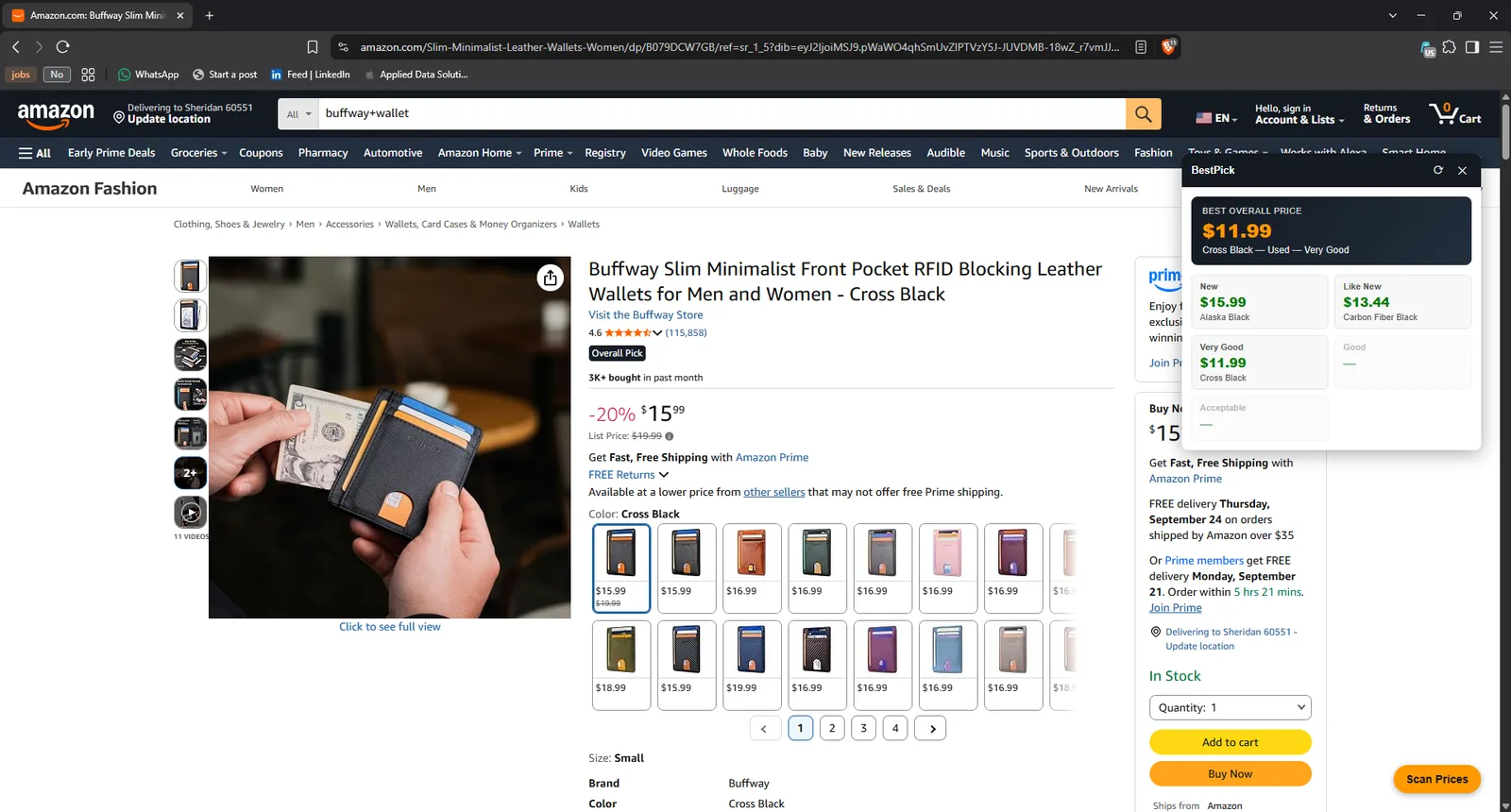
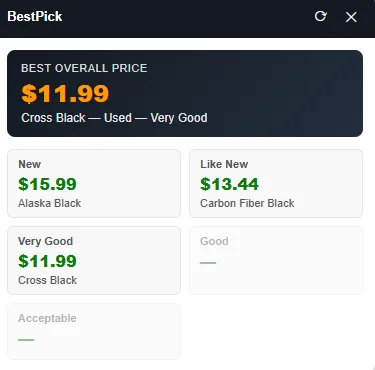
Amazon listings can have dozens of variants, each with its own third-party offers in five conditions. Checking them by hand means opening every variant. BestPick scans them all in one pass and shows the cheapest option.
- Conditions priced per variant
- 5
- Concurrent fetch workers
- 5
- Faster than one-at-a-time fetching
- ~2×
- From launch to v1.1
- 24 h
How it works
- 1
Detect variants
Content script finds every variant swatch on the product page
- 2
Queue
Each variant's offer listing goes into a shared queue
- 3
Fetch
Pool of 5 workers, each with a randomized 250–600 ms delay
- 4
Parse
Match condition headings in the markup and take the lowest price under each
- 5
Stream
One result message per variant as it completes, then a done signal
- 6
Display
Best overall price, a card per condition, and a sortable detail table
Design decisions
- Rate-limit aware: if Amazon's bot check appears repeatedly, the scan stops and starts a cooldown (5 minutes, doubling up to a 1-hour cap) instead of reporting a false “no offers found”.
- Resilient parsing: prices are found by matching the condition heading text, not CSS class names, which Amazon changes over time.
- No account ties: every fetch omits credentials, so scans are not linked to the shopper's Amazon session.
- No telemetry: the only network calls are to amazon.com for the scan itself.
- One scan, all conditions: each variant is fetched once, and switching tabs or sort order never re-fetches.
Architecture
- Manifest V3 with no build step or bundler.
- The service worker is an ES module split by concern: config, parser, scanner, cooldown and entry point.
- The panel UI runs as content scripts sharing one namespace object, split into state, rendering and event binding.
- Built with AI assistance: I designed the architecture first, then implemented and iterated with Claude.
Figures
Built with
JavaScriptChrome ExtensionsManifest V3Async/ConcurrencyHTML Parsing